
Beginner
Learn the shape of the skill with a cooperative feed, a large target, and enough time to recover balance.
Practice that transfers to games
Choose a plain-language experience level, work on one real point pattern, and leave the court with a number that tells you what to repeat next.
Start at the right challenge
A practice level should change the feed, target, pace, decision, and success standard. It should not merely change the label above the same drill.
Learn the shape of the skill with a cooperative feed, a large target, and enough time to recover balance.
Repeat a stable pattern, add one recovery step, and count quality attempts rather than lucky winners.
Add movement, placement, and a clear decision while keeping the ball pattern connected to a real point.
Randomize the read, apply score pressure, and measure whether the right choice survives at competitive pace.
Personal practice planner
Tell the planner your experience, goal, days, minutes, format, partner experience, and actual setup. It creates two to five different sessions with exact time blocks, cues, measures, common misses, easier and harder versions, and a game-transfer finish.
Access is immediate. There is no account password, cart, payment, or checkout. Joining Pocket Pickle Weekly is a separate optional choice.
Personal practice plan
Build a focused plan around your level, goal, schedule, and available practice setup.
Use the setup you really have
Do not abandon practice because the ideal court, basket, or partner is unavailable.
Serve targets, drop feeds, shadow movement, and a wall can develop repeatable contact without inventing a partner.
Open solo drills →Define the feeder’s job, trade roles, and keep cooperation long enough for both players to own the pattern.
Open two-player drills →Shorten the space, increase repetitions, and use a target that rewards height, depth, or recovery—not pace alone.
Open beginner drills →Connect serve, return, transition, kitchen control, pressure, and review across a complete month.
Open the 30-day system →Complete drill library
Each guide explains setup, target, progression, common mistakes, and how the drill should appear in a game.
Five foundational drills for legal contact, depth, ready position, dinks, and movement.
Build reliable contact →Build a legal, repeatable motion before adding zones, pressure, or extra pace.
Practice the serve →Control height, direction, recovery, patience, and the decision to speed up.
Own the soft game →Train arc, landing depth, forward movement, and the fifth ball after the drop.
Shape a useful drop →Compact contact, ready-position recovery, blocks, redirection, and faster exchanges.
Train faster hands →Make partner court time purposeful with clear roles, targets, and role changes.
Plan partner practice →Use a wall, targets, serves, drop feeds, or shadow work without pretending it is live play.
Practice by yourself →Diagnose one weakness, measure it, progress it, and test it in a real point pattern.
Follow the month →Use the strategy guide when your basics are stable and decisions under pressure are the main constraint.
Read advanced patterns →A repeatable session recipe
Use this structure when you build a session yourself. Adjust the volume and movement to your health, available time, and court conditions.
Begin with easy movement and cooperative contact. The goal is readiness, not fatigue.
Use a predictable feed and a visible target until the cue and recovery become repeatable.
Change placement, movement, pace, or decision uncertainty one at a time.
Finish with a short scored game that rewards the practiced decision, then write one next adjustment.
Free 34-page PDF
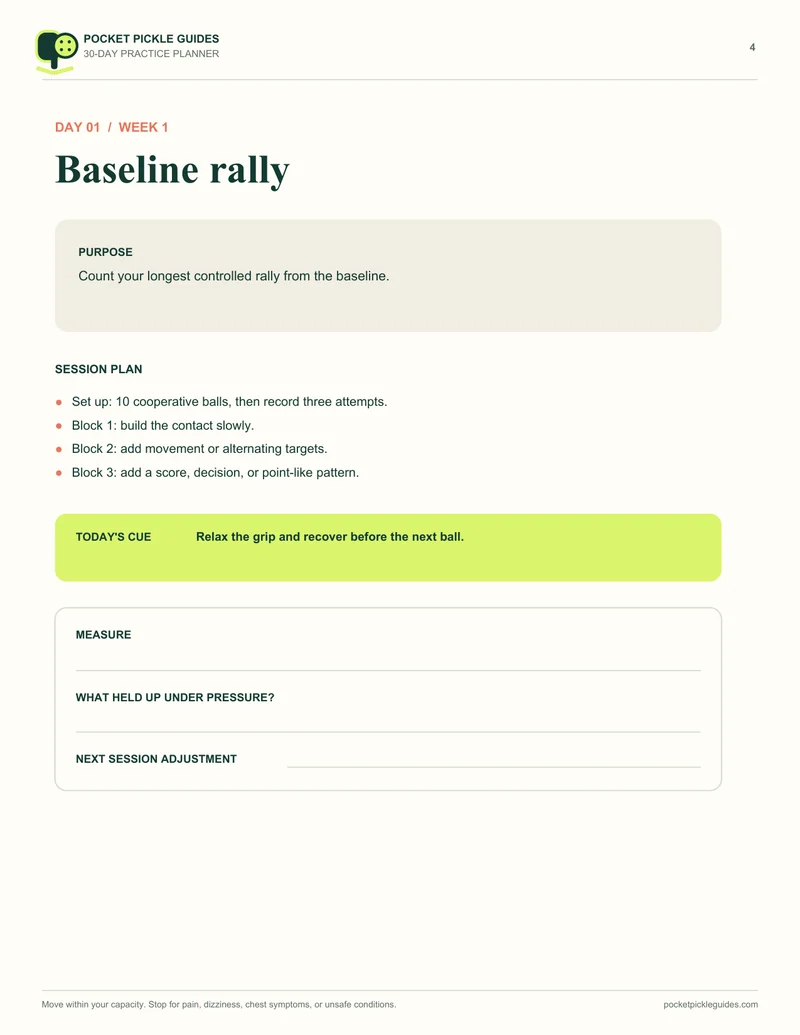
The planner adds a starting snapshot, thirty distinct daily pages, pressure and game-transfer prompts, measurable fields, a final check, and a month-end review.
Free reader access
Enter your email once. This browser stays unlocked for 30 days.
Unlocked on this browser. No payment required.
Practice questions
Usually one main skill and one short game-transfer finish are enough. More topics often reduce useful repetitions and make the reason for a miss harder to see.
Keep feeds cooperative, use a larger target, and trade roles only after both players understand the pattern. The planner asks for partner experience and changes the feeder’s job accordingly.
Begin with enough margin to repeat the intended contact and recovery. Add pace only when the ball shape and balance remain dependable.
No. Use rest days, repeat a session, and adapt workload to your circumstances. The 30-day plan is a progression, not a demand for thirty consecutive court days.