How to get better at pickleball: a 30-day improvement system

Improve faster by choosing one costly pattern, measuring it in practice, adding pressure gradually, and checking whether the skill appears in real games.

Quick answer

Pick one weakness for four weeks, practice it two or three times each week, count a simple success measure, and finish every session with a game-like constraint that forces the new skill to appear.

Find the pattern that costs organized points

Do not start with the flashiest shot. Track first-four-ball errors, short returns, missed serves, transition pop-ups, attack choices, or balls lost through the middle. Choose the pattern that appears repeatedly.

Give the skill one measure

Use a number you can collect without stopping practice: legal serves out of 20, returns beyond a target, cooperative dink streak, drops into a landing zone, or resets that force a neutral next ball.

Use a four-week progression

  1. 01

    Week 1: shape

    Slow the ball down and build clean contact from a comfortable position.

  2. 02

    Week 2: movement

    Add recovery steps, alternating directions, or a realistic feed.

  3. 03

    Week 3: pressure

    Add a score, decision, or consequence while preserving the target.

  4. 04

    Week 4: transfer

    Use a constrained game that rewards the skill, then track it in normal play.

Keep most repetitions cooperative

For a developing skill, spend most of the block building the pattern, a smaller portion making decisions, and the final portion competing. Constant competition can hide the exact contact you need to improve.

Review the evidence after four weeks

Keep the focus if quality and game transfer are rising. Make the drill easier if form disappears, or choose a new bottleneck when the old pattern no longer costs many points.

Quick answers before you play.

How often should I practice pickleball to improve?

Two or three focused sessions each week can be useful when the target is specific and the repetitions remain high quality. Recovery and individual capacity still matter.

Should I play games or drill more?

Use both. Drills create repeatable contact; constrained games add decisions and pressure; normal games reveal whether the skill transfers.

What should a beginner improve first?

Reliable legal serves, deep returns, ready position, simple volleys, and cooperative rally consistency usually create the broadest early benefit.
Useful next step

Build your first focused practice week

Keep going

Thirty sessions, from reliable contact to patient point patterns.

Move through the sessions in order. The plan begins with repeatable contact, adds touch and transition work, then asks those skills to survive decisions, score pressure, and a normal game.

Use a 20- to 45-minute window for full practice days. Checkpoint, planning, and review days can be shorter. Keep the named setup, record the finish, and use only the single cue shown for that day.

Week 1Days 1–7

Consistency and ready position

Build a calm baseline first. Count repeatable balls, protect margin, and add movement only after contact and recovery stay controlled.

  1. Day 01

    Baseline rally

    Count your longest controlled rally from the baseline.

    Setup / finish
    10 cooperative balls, then record three attempts.
    Today’s cue
    Relax the grip and recover before the next ball.
  2. Day 02

    Serve targets

    Build a legal serve you trust under light pressure.

    Setup / finish
    20 serves: 10 deep middle, 5 wide, 5 body.
    Today’s cue
    Use one repeatable routine before every ball.
  3. Day 03

    Return depth

    Create time to move forward behind the return.

    Setup / finish
    20 returns beyond a target line; score 1 per success.
    Today’s cue
    Prioritize height and depth before speed.
  4. Day 04

    Ready position

    Arrive balanced before the opponent contacts the ball.

    Setup / finish
    Shadow split-step, then 3 sets of 8 live feeds.
    Today’s cue
    Stop moving at contact instead of running through the shot.
  5. Day 05

    Groundstroke consistency

    Reduce first-four-ball errors.

    Setup / finish
    Crosscourt forehands and backhands, 3 x 12 balls.
    Today’s cue
    Choose margin over the sideline.
  6. Day 06

    Kitchen reset

    Soften a fast ball into an unattackable bounce.

    Setup / finish
    Partner feeds 15 balls from midcourt; land 8 in the kitchen.
    Today’s cue
    Absorb pace with quiet hands.
  7. Day 07

    Week 1 review

    Turn numbers into one useful adjustment.

    Setup / finish
    Repeat your weakest test and write one cue.
    Today’s cue
    Keep the cue short enough to use during play.
Week 2Days 8–14

Dinks, volleys, and communication

Begin cooperatively, then add direction, decisions, and a simple score. The ball should stay controllable while the information becomes less predictable.

  1. Day 08

    Dink height

    Send the ball over the net with safe, low margin.

    Setup / finish
    Cooperative straight-ahead dinks; count a best streak.
    Today’s cue
    Lift with the shoulder instead of flicking the wrist.
  2. Day 09

    Crosscourt dinks

    Use the longer diagonal and recover to balance.

    Setup / finish
    3 rounds to 20 cooperative balls crosscourt.
    Today’s cue
    Recover before changing direction.
  3. Day 10

    Dink direction

    Move the opponent without forcing a winner.

    Setup / finish
    Alternate middle and sideline targets for 24 balls.
    Today’s cue
    Keep the same compact preparation.
  4. Day 11

    Attack decision

    Separate attackable balls from neutral balls.

    Setup / finish
    Call attack or reset before contact on 20 feeds.
    Today’s cue
    Attack height and balance, not impatience.
  5. Day 12

    Volley blocks

    Return pace with a compact paddle path.

    Setup / finish
    3 x 10 controlled blocks from the kitchen line.
    Today’s cue
    Keep the paddle in front and finish small.
  6. Day 13

    Partner middle balls

    Make ownership obvious before pressure arrives.

    Setup / finish
    Play half-court points and call mine or yours early.
    Today’s cue
    Use one agreed rule for balls through the middle.
  7. Day 14

    Week 2 checkpoint

    Test whether touch survives a simple score.

    Setup / finish
    Play dink points to 7; only kitchen errors score.
    Today’s cue
    Track the error pattern, not just who wins.
Week 3Days 15–21

Transition and third-ball choices

Build each shape from a stable base, add the recovery step, then connect the shot to the next decision. Moving forward is earned by ball quality.

  1. Day 15

    Transition resets

    Neutralize pace while moving toward the kitchen.

    Setup / finish
    Start midcourt; earn the line with 3 good resets.
    Today’s cue
    Stop and balance before soft contact.
  2. Day 16

    Third-shot drop shape

    Create an arc that lands in the kitchen.

    Setup / finish
    5 sets of 6 drops from a comfortable distance.
    Today’s cue
    Give the ball room to clear the net.
  3. Day 17

    Drive plus fifth

    Use the drive to earn a manageable next ball.

    Setup / finish
    Drive the third, then reset or drop the fifth for 18 reps.
    Today’s cue
    Do not admire the drive – prepare for the next ball.
  4. Day 18

    Approach footwork

    Move forward only behind a ball that buys time.

    Setup / finish
    Serve, return, third shot, then freeze at opponent contact.
    Today’s cue
    Advance in stages instead of charging blindly.
  5. Day 19

    Lob recovery

    Turn around safely and rebuild the rally.

    Setup / finish
    Practice crossover turn, run, bounce, and controlled return.
    Today’s cue
    Avoid backpedaling under a deep lob.
  6. Day 20

    Overhead control

    Finish high balls without overhitting.

    Setup / finish
    15 overheads to a deep middle target.
    Today’s cue
    Contact in front and recover after the swing.
  7. Day 21

    Week 3 pattern

    Connect serve, return, third shot, and kitchen decision.

    Setup / finish
    Play 10 first-four-ball sequences with a partner.
    Today’s cue
    Judge the pattern by ball quality, not point result.
Week 4Days 22–30

Point patterns and transfer

Use one intention under score pressure, keep the routine after misses, and finish with a normal game. Day 30 compares evidence instead of relying on memory.

  1. Day 22

    Deep serve plus third

    Create a predictable third-ball opportunity.

    Setup / finish
    10 points starting with a deep target serve.
    Today’s cue
    Use depth without sacrificing serve reliability.
  2. Day 23

    Deep return plus advance

    Reach the kitchen behind time and depth.

    Setup / finish
    10 returns, move forward, then split-step on contact.
    Today’s cue
    Do not watch the return while standing still.
  3. Day 24

    Patient point pattern

    Win with fewer rushed choices.

    Setup / finish
    Serve, deep return, safe third, then play crosscourt first.
    Today’s cue
    Build the point before changing direction.
  4. Day 25

    Kitchen patience

    Stay neutral until a real attack appears.

    Setup / finish
    Play to 7; attacks below net height lose the rally.
    Today’s cue
    Let a neutral ball remain neutral.
  5. Day 26

    Pressure scoring

    Keep the routine when the score matters.

    Setup / finish
    Serve targets: first to 11, lose 2 for a miss.
    Today’s cue
    Breathe, call the target, and use the same tempo.
  6. Day 27

    Target the weaker pattern

    Use observation without chasing winners.

    Setup / finish
    Play 8 points through one safe target zone.
    Today’s cue
    Aim big and notice the next ball you receive.
  7. Day 28

    Partner game plan

    Agree on two patterns before play.

    Setup / finish
    Write one serve-return pattern and one middle-ball rule.
    Today’s cue
    Use clear language both partners can remember.
  8. Day 29

    Mock match

    Transfer the month into normal decisions.

    Setup / finish
    Play one game to 11 and track three chosen behaviors.
    Today’s cue
    Do not add a new cue during the match.
  9. Day 30

    Retest and next month

    Compare evidence and choose the next bottleneck.

    Setup / finish
    Repeat Day 1 plus your two most important tests.
    Today’s cue
    Keep the focus that is improving; replace the one that is not.
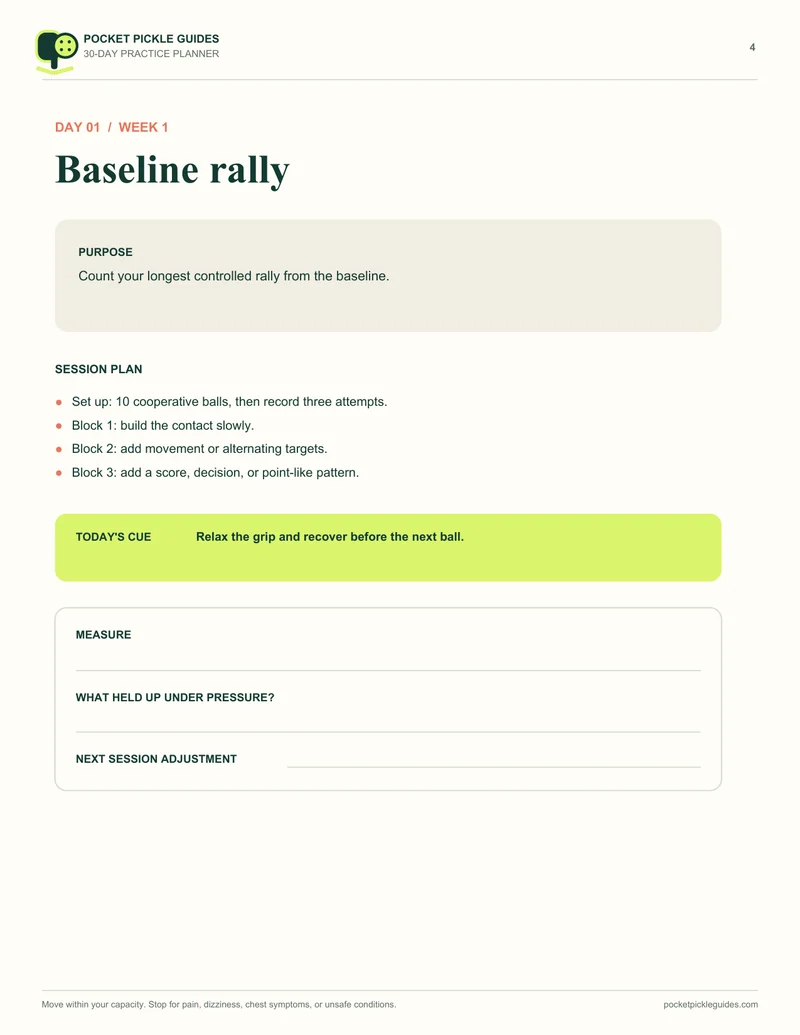
Actual daily Baseline Rally page from the 30-Day Pickleball Practice Planner
An actual daily page from the complete 34-page planner.

Turn the public 30-day system into a practice journal.

The downloadable planner puts the complete public plan into thirty print-ready daily pages, with a starting snapshot, progressive pressure and game-transfer prompts, measurable fields, a Day 30 check, and a month-end review.

  • Thirty distinct practice pages
  • Partner and solo adaptations
  • No price, cart, or checkout

Free reader access

Unlock every free tool and guide

Enter your email once. This browser stays unlocked for 30 days.

Immediate access; no account or payment. Read the privacy policy.