
Health / 8 min read / reviewed July 21, 2026
Pickleball mobility: a 7-minute warmup and cooldown
Use five minutes of easy, court-specific movement before play and two minutes to ease down afterward.
Before pickleball, move easily for five minutes: walk or march, rock through the feet, step side to side, hinge and bend comfortably, then rehearse slow court movements. After play, walk until your breathing eases and use gentle calf or forearm stretching only if it feels comfortable. Never force range or bounce into a stretch.
Free PDF after one reader unlock
Take the seven-minute sequence to the court.
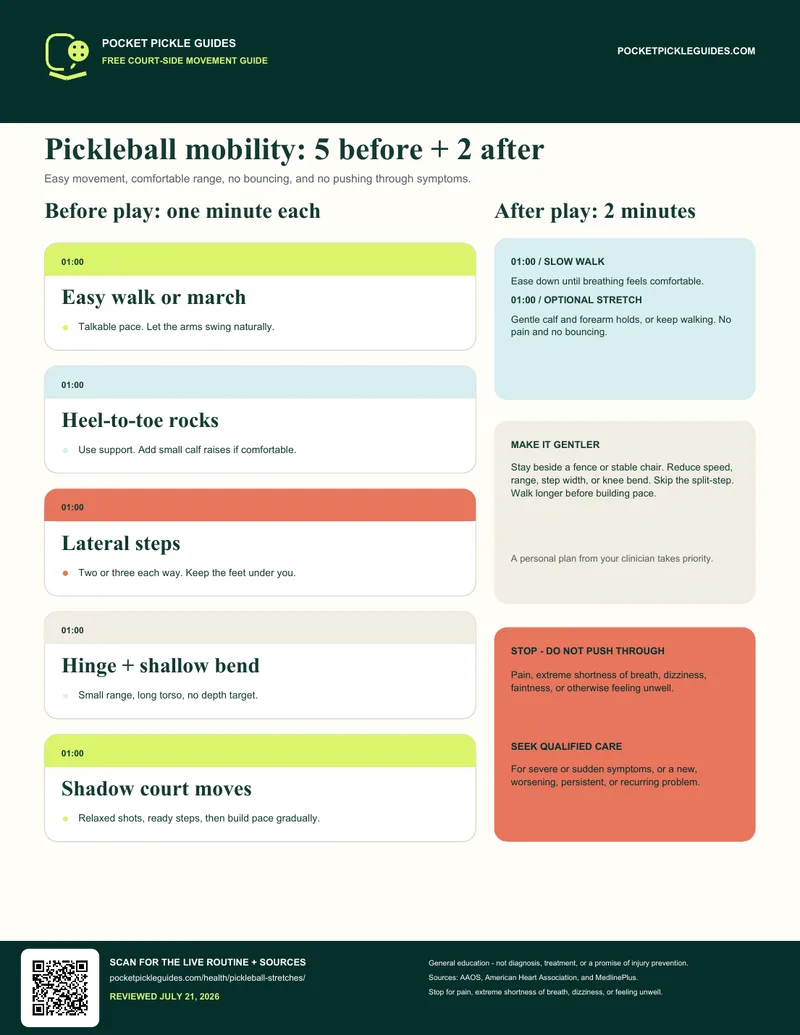
The one-page PDF has five timed pre-play movements, a two-minute cooldown, modification cues, stop signs, and a QR link back to this evergreen guide.
- 1-page US Letter PDF
- Selectable text and crisp vector graphics
- Reviewed July 21, 2026
Free reader access
Unlock every free tool and guide
Enter your email once. This browser stays unlocked for 30 days.
Unlocked on this browser. No payment required.
Five minutes before play
Move first, then rehearse the court
AAOS recommends beginning a warmup with easy aerobic activity and using standing movement once muscles are warm. This sequence stays intentionally simple. Use a wall, fence, or chair for balance and keep every motion inside a comfortable range.
- 01:00
Easy walk or march
Walk the court perimeter or march in place. Keep a pace that lets you talk comfortably. Let your arms swing without forcing them overhead.
- 01:00
Heel-to-toe rocks and calf raises
With support nearby, rock gently from heels toward the balls of the feet. Add small calf raises if comfortable. Keep the movement controlled rather than bouncing.
- 01:00
Lateral steps
Take two or three easy steps each way in an athletic stance. Keep the feet under you and make the range smaller if balance or knees feel uncertain.
- 01:00
Hip hinges and shallow knee bends
Send the hips slightly back with a long torso, return to tall, then add only the amount of knee bend that feels easy. This is movement practice, not a depth test.
- 01:00
Shadow shots and ready-position steps
Rehearse a relaxed forehand, backhand, serve motion, and a few small split-step or reach patterns without a ball. Build toward game pace gradually after the routine.
Two minutes after play
Ease down before optional stretching
- 01:00
Slow walk
Walk at an easy pace and let your breathing settle gradually. The American Heart Association advises lowering activity progressively rather than stopping abruptly after harder exercise.
- 01:00
Comfortable calf and forearm stretch
Once you are breathing easily, use support and hold a gentle calf position for about 15 seconds per side. Use the remaining time for a relaxed forearm stretch, or simply keep walking. No bouncing and no pain.
You do not have to chase a bigger range. A mild, comfortable stretch is enough. Mobility is one court-readiness habit; it does not replace gradual training, recovery, appropriate shoes, or individual care for a symptom.
Three ways to modify the routine
| If you need… | Try this | Avoid assuming |
|---|---|---|
| More balance support | Stay beside a fence, wall, or stable chair; reduce step width and speed | That an unsupported version is automatically better |
| A gentler start | Walk longer, make every range smaller, and skip the split-step | That seven minutes must look identical for every player |
| More preparation | Repeat the easy walk and shadow sequence, then increase pace gradually | That deeper stretching is the missing ingredient |
A modification should make the movement feel more controlled—not help you push through symptoms. If a clinician has given you a personal plan, that plan takes priority.
Stop signs and the boundary of a general routine
- Stop the movement for pain, extreme shortness of breath, dizziness, faintness, or if you otherwise do not feel right.
- Get urgent help for severe or sudden symptoms such as chest pressure, fainting, or difficulty breathing.
- Ask a qualified clinician about a new, worsening, persistent, or recurring symptom instead of using this page as a treatment plan.
- Do not use stretching to test an injury. More range is not the goal when something hurts.
MedlinePlus advises stopping exercise and seeking help for pain, extreme shortness of breath, dizziness, or feeling unwell. Local emergency guidance and your clinician’s instructions control.
Educational routine reviewed July 21, 2026 against AAOS warmup, cooldown, and flexibility guidance, the American Heart Association warmup and cooldown guide, and MedlinePlus exercise safety guidance. These sources support general sequencing and safety boundaries; they do not validate this as a personalized injury-prevention or rehabilitation program.
Common questions
Pickleball mobility questions
What is a simple pickleball mobility routine?
Use five minutes before play: easy walking, heel-to-toe rocks, lateral steps, comfortable hinges and knee bends, then slow shadow shots. After play, walk for one minute and add a gentle calf or forearm stretch only if it feels comfortable.
Should I stretch before playing pickleball?
Start with easy movement so you are not stretching cold muscles. Once warm, comfortable standing mobility can be part of preparation. Save longer relaxed holds for after your breathing has eased, and never bounce or stretch into pain.
Can mobility prevent pickleball injuries?
No short generic routine can promise injury prevention. Mobility may help you transition into activity and rehearse court movement, but training load, strength, balance, recovery, footwear, surface, health, and chance also matter.
What if a pickleball stretch hurts?
Stop. Stretching should not hurt and this routine is not a way to diagnose or test an injury. Seek qualified care for a serious, new, worsening, persistent, or recurring symptom.
Can I do the routine seated or with support?
Use stable support and reduce range, speed, or step width as needed. Some movements can be rehearsed seated, but a generic page cannot decide whether a version is safe for a particular condition or balance concern.